
Cybernetics and the Viable System Model — the object under test
Area. Management cybernetics; first- and second-order cybernetics; the VSM’s own literature, critiques, empirical tests and history.
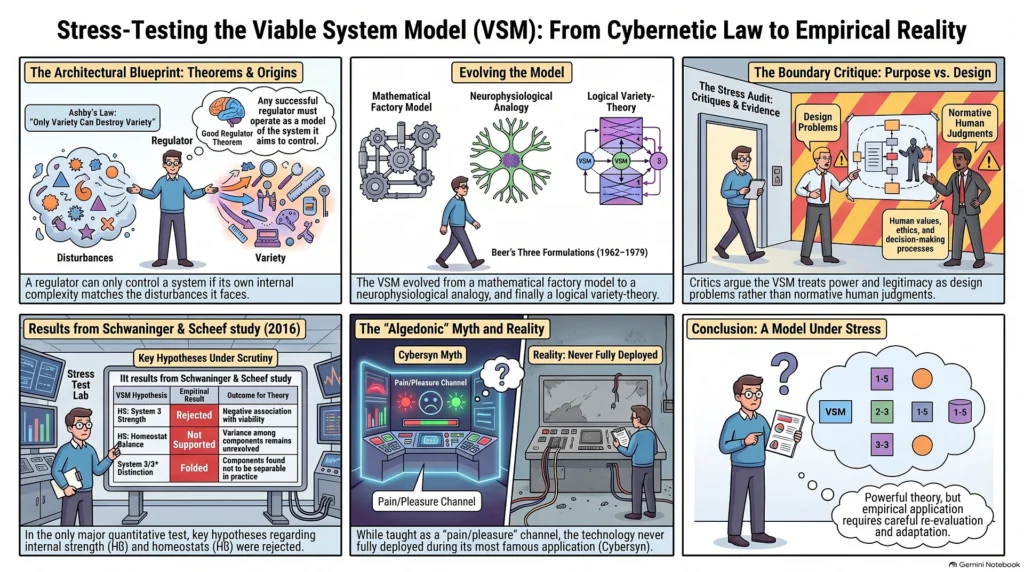
Introduction. Ashby gave cybernetics its two theorems: only variety can destroy variety, and every good regulator of a system must be a model of that system. Beer built the VSM on them in three successive forms — set-theoretic (1962), neurophysiological (Brain of the Firm, 1972/1981), and logical-graphical (Heart of Enterprise, 1979; Diagnosing the System, 1985). The model’s five functions, its recursion axiom and its channels have been elaborated by a community (Espejo, Schwaninger, Pérez Ríos, Espinosa & Walker) that has produced diagnostic taxonomies and applications but only one statistical test. The critiques exist — Ulrich’s 1981 exchange with Beer, Jackson’s 1988 appreciation, critical systems thinking — but they have not accumulated into revisions. Cybersyn is the model’s one national-scale implementation and its algedonic meters never shipped.
Three names. W. Ross Ashby, Stafford Beer, Markus Schwaninger (for the test); then Werner Ulrich and Michael C. Jackson for the critiques.
Importance for cybernetics / VSM. This is the object. Everything else in the program is an instrument applied to it.
Importance for the article. §1–§3 and §5–§6 are built here: the “exposure without accumulation” claim, Demonstration 0 on Schwaninger & Scheef, and Demonstration I on the corpus. The single most important unread item in the whole inquiry is Beer (1962): whether a set-theoretic formulation exists and was abandoned decides what Demonstration IV can build on.
Start here.
- read the actual paper; Demonstration 0 depends on your knowing H3, H8 and the 3/3* collapse first-hand.
- the logical derivation and the Principles of Organization that Demonstration II targets.
- the documented adversarial exchange.
- the completed provenance audit the paper wants to emulate.
One outside text. Pickering, A. (2010). The Cybernetic Brain: Sketches of Another Future. University of Chicago Press — the intellectual history of Ashby, Beer and Pask that places the brain analogy in its time.