
Complexity science, ecology and evolution
Area. NK fitness landscapes and organisational search; firm mortality and scaling; resilience, panarchy and early-warning signals; self-organised criticality and its critics; major evolutionary transitions, cultural evolution and niche construction.
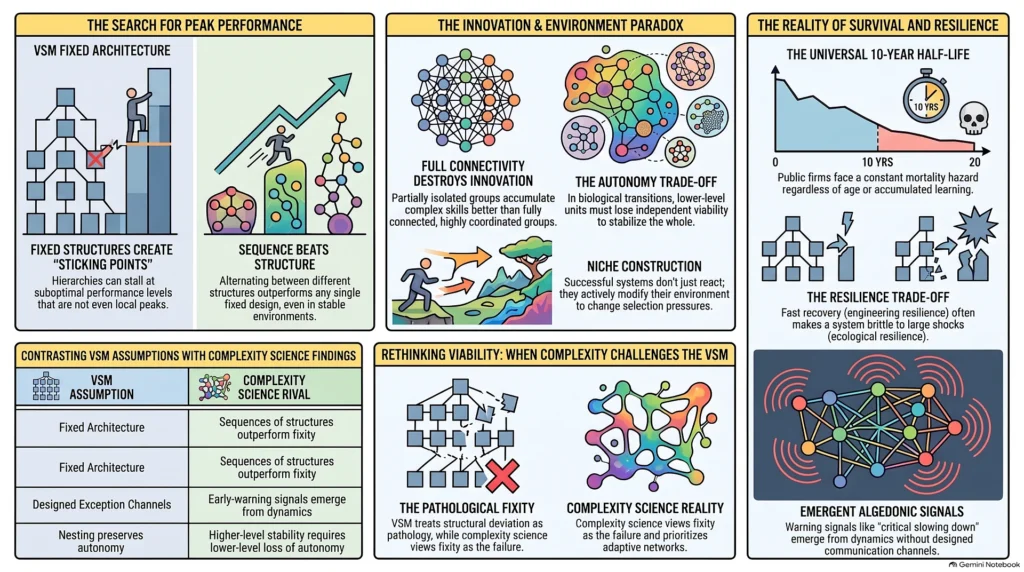
Introduction. Complexity science is the continuation of Beer’s question — what is the invariant organisation of systems that persist — with simulation, proofs and data. Rivkin, Siggelkow and Levinthal showed on NK landscapes that hierarchies get stuck at points that are not even local optima and that sequences of structures beat any fixed structure. Daepp, West and colleagues found a constant hazard rate for firms — half-life ten years regardless of age — which no VSM study has used as an outcome. Holling separated engineering from ecological resilience; panarchy gives persistence a release phase the VSM lacks; Scheffer’s early-warning signals are an alarm that arises from dynamics rather than design. Maynard Smith and Szathmáry showed that nesting removes independent viability — the opposite of Beer’s recursion axiom. Derex and Boyd showed that partial connectivity beats full connectivity for innovation.
Three names. Nicolaj Siggelkow (with Daniel Levinthal), Geoffrey West, C. S. Holling.
Importance for cybernetics / VSM. These results contradict the VSM’s fixed architecture, its monotonic “more coordination is better” reading of System Two, and its recursion axiom, using outcome variables the tradition has never measured.
Importance for the article. §2.1 (five senses of viability, the major-transitions objection), §3.3 and §10.5 (NK results, firm-survival cohort study, Perrow’s contradiction answered by alternation), §11.4 (architectural-universals framing endorsed but not adopted).
Start here.
- time-varying structure.
- the outcome variable.
- the two resiliences.
- chapter 1, the independent-replication criterion.
- the non-monotonic connectivity result.
More Details
This theme collects the sciences that ask Beer’s question—what organisation lets a system persist?—with simulations, survival data and evolutionary evidence, and that answer it differently. NK-landscape simulation says fixed architecture is the pathology; the firm-mortality record supplies the one outcome variable that is viability rather than a proxy; resilience ecology splits Beer’s compound "viability" into senses that trade off and shows that warning signals emerge from dynamics without a designed channel; criticality theory is a staged rival that would make System Two harmful if it held; the major transitions and cultural evolution show that nesting removes independent viability and that full connectivity destroys innovation. Take the sub-themes in spec order, except that 8.3 can usefully precede 8.1 for a reader coming straight from §2.1, since the five senses of viability frame everything else.
Fitness landscapes and organisational search
A fitness landscape maps each possible configuration of a system to a performance value. Kauffman’s NK model makes the landscape’s ruggedness tunable: N components each contribute to fitness, and each contribution depends on the component’s own state and on K others. With K = 0 the landscape has a
Firm mortality and scaling
The scaling programme associated with Geoffrey West and Luís Bettencourt looks for quantitative regularities in organisms, cities and firms that any general theory must explain. Daepp, Hamilton, West and Bettencourt applied survival analysis to more than 25,000 publicly traded North American companies between 1950 and 2009 and found an
Resilience, the adaptive cycle and early-warning signals
Holling’s 1973 review separated two properties that management language runs together. Stability, later called engineering resilience, is the speed of return to equilibrium after disturbance. Resilience, later ecological resilience, is the amount of disturbance a system can absorb before it flips into a different regime with its own attractor.
Self-organised criticality and its critics
Bak, Tang and Wiesenfeld proposed in 1987 that slowly driven, extended dissipative systems evolve spontaneously to a critical state with no characteristic scale, so that event sizes follow power laws and time series show 1/f noise, without any parameter being tuned. The sandpile is the canonical model: grains added
Major transitions, cultural evolution and niche construction
Three lines from evolutionary biology and anthropology. Maynard Smith and Szathmáry identified a series of major transitions—replicating molecules to chromosomes, prokaryotes to eukaryotes, cells to multicellular organisms, solitary individuals to eusocial colonies, primate societies to language-using societies—that share one form: entities capable of independent replication before the transition can