
Neuroscience — the adequacy of Beer’s brain analogy
Area. McCulloch’s heterarchy and the reticular formation; neuromodulation and uncertainty; affective neuroscience (liking/wanting; the dACC controversy); cortical hierarchy, intrinsic timescales and the canonical microcircuit.
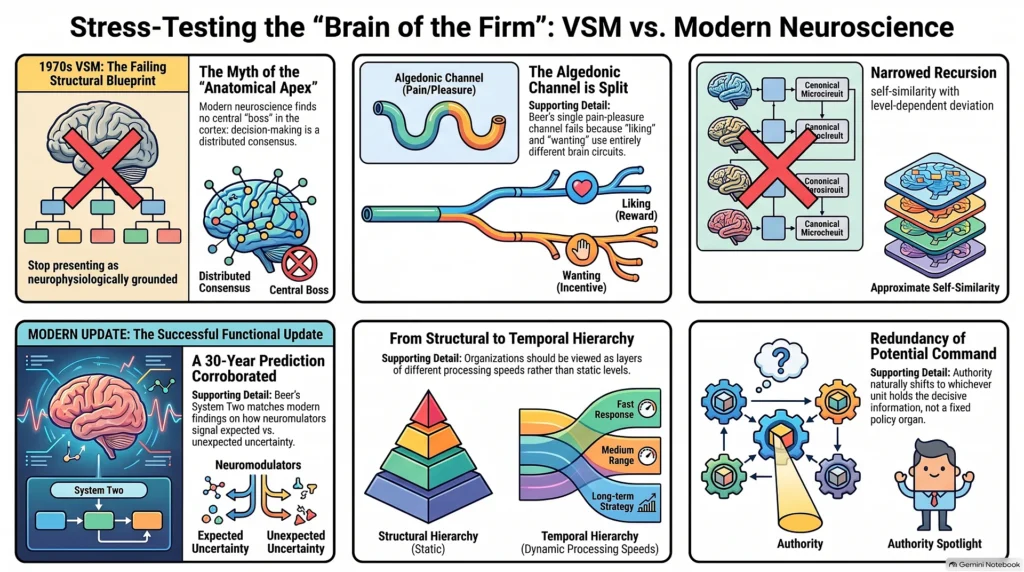
Introduction. Beer mapped his five systems onto spinal cord, brainstem, diencephalon and cortex. Judged by current neuroscience the mapping fails unevenly. McCulloch — Beer’s own source — argued in 1945 that the nervous system does not implement a value hierarchy with an apex, and in 1969 described the reticular formation as a distributed consensus with no fixed escalation path. Yu and Dayan’s split between expected uncertainty (acetylcholine) and unexpected uncertainty (norepinephrine) maps well onto System Two versus the algedonic exception. Berridge and Kringelbach show that pain and pleasure are not one axis and that wanting and liking dissociate — a distinction the VSM lacks. The anatomical hierarchy of cortex is a graded gradient, not a ladder, but the hierarchy of intrinsic timescales is real and replicated.
Three names. Warren McCulloch, Peter Dayan, Kent Berridge.
Importance for cybernetics / VSM. No VSM publication found connects algedonics to affective neuroscience; the term itself predates Beer and its neuroanatomical gloss is sourced to a VSM applications paper.
Importance for the article. Demonstration Ib (§6.2): one claim strengthens, one narrows, one loses structure but keeps function, one is contradicted by the tradition’s own source — the receipt protocol working. §8’s timescale-stratification arm reformulates recursion.
Start here.
- four pages; the contradiction of System Five.
- the strongest surviving claim.
- the liking/wanting distinction.
- recursion as timescale strata.
One outside text. McCulloch, W. S. (1965). Embodiments of Mind. MIT Press — the collected papers, including the heterarchy paper and the reticular-formation work, in the author’s own framing.