
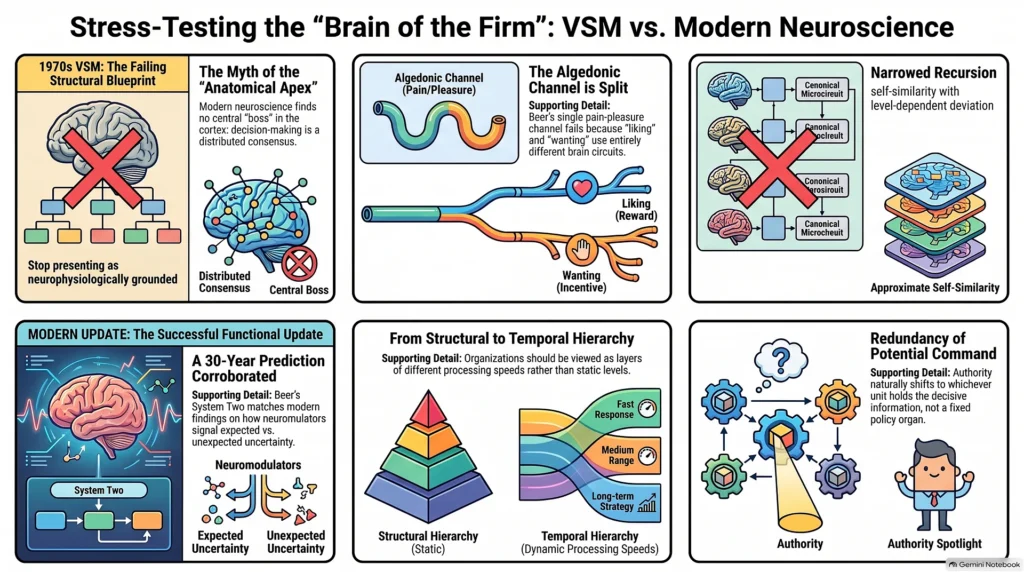
Neuroscience — the adequacy of Beer’s brain analogy
Area. McCulloch’s heterarchy and the reticular formation; neuromodulation and uncertainty; affective neuroscience (liking/wanting; the dACC controversy); cortical hierarchy, intrinsic timescales and the canonical microcircuit.
Introduction. Beer mapped his five systems onto spinal cord, brainstem, diencephalon and cortex. Judged by current neuroscience the mapping fails unevenly. McCulloch — Beer’s own source — argued in 1945 that the nervous system does not implement a value hierarchy with an apex, and in 1969 described the reticular formation as a distributed consensus with no fixed escalation path. Yu and Dayan’s split between expected uncertainty (acetylcholine) and unexpected uncertainty (norepinephrine) maps well onto System Two versus the algedonic exception. Berridge and Kringelbach show that pain and pleasure are not one axis and that wanting and liking dissociate — a distinction the VSM lacks. The anatomical hierarchy of cortex is a graded gradient, not a ladder, but the hierarchy of intrinsic timescales is real and replicated.
Three names. Warren McCulloch, Peter Dayan, Kent Berridge.
Importance for cybernetics / VSM. No VSM publication found connects algedonics to affective neuroscience; the term itself predates Beer and its neuroanatomical gloss is sourced to a VSM applications paper.
Importance for the article. Demonstration Ib (§6.2): one claim strengthens, one narrows, one loses structure but keeps function, one is contradicted by the tradition’s own source — the receipt protocol working. §8’s timescale-stratification arm reformulates recursion.
Start here.
- four pages; the contradiction of System Five.
- the strongest surviving claim.
- the liking/wanting distinction.
- recursion as timescale strata.
One outside text. McCulloch, W. S. (1965). Embodiments of Mind. MIT Press — the collected papers, including the heterarchy paper and the reticular-formation work, in the author’s own framing.
More Details
This theme is the neuroscience needed to defend Demonstration Ib (§6.2), which takes Beer’s canonical mapping—System Five as cortex, Four as diencephalon, Three as autonomic base, Two as sympathetic ganglia, the algedonic channel as a pain–pleasure signal converging on the reticular formation, recursion as the repeated cortical microcircuit—and asks, component by component, whether current neuroscience supports it. The finding v02 defends is that the mapping fails unevenly: one component is contradicted by Beer’s own sources, one is anatomically off-target but functionally right, one is half-corroborated and half-wrong, and one narrows. A practitioner needs enough of each field to state the proposition in neuroscientific terms, stripped of VSM vocabulary, as the blind-panel test requires. The spec order follows §6.2’s own sequence and should be kept: 6.1 (apex and reticular formation), 6.2 (the algedonic corroboration), 6.3 (the algedonic failure), 6.4 (recursion and timescales, which also feeds Demonstration IIIc).
McCulloch, heterarchy and the reticular formation
Two papers by Warren McCulloch and his collaborators bear on whether a nervous system has an apex. The 1945 paper shows that a net with circular connections can produce intransitive preferences—A chosen over B, B over C, C over A. A hierarchy of values requires transitivity, so such a
Neuromodulation and uncertainty
Neuromodulators—acetylcholine, norepinephrine, dopamine, serotonin—are released by small brainstem and basal-forebrain nuclei that project broadly across cortex and change the gain and learning rate of the circuits they reach, rather than carrying specific content. Yu and Dayan proposed that two of them carry two kinds of uncertainty. Acetylcholine signals expected
Affective neuroscience: liking, wanting and the social-pain controversy
Affective neuroscience separates what everyday language and Beer’s "algedonic" treat as one axis. Berridge and Kringelbach’s review distinguishes "liking," the hedonic impact of a reward, from "wanting," incentive salience or the motivation to obtain it. Liking is generated in a few small hedonic hotspots—in the nucleus accumbens shell, the
Cortical organisation: hierarchy, timescales and the canonical microcircuit
"Hierarchy" in cortical neuroscience has several senses, and Beer’s analogy uses two. The first is anatomical: a top level that commands. Badre and D’Esposito review the evidence that lateral frontal cortex is organised along a rostro-caudal gradient, more anterior regions supporting more abstract control, and ask whether the gradient