
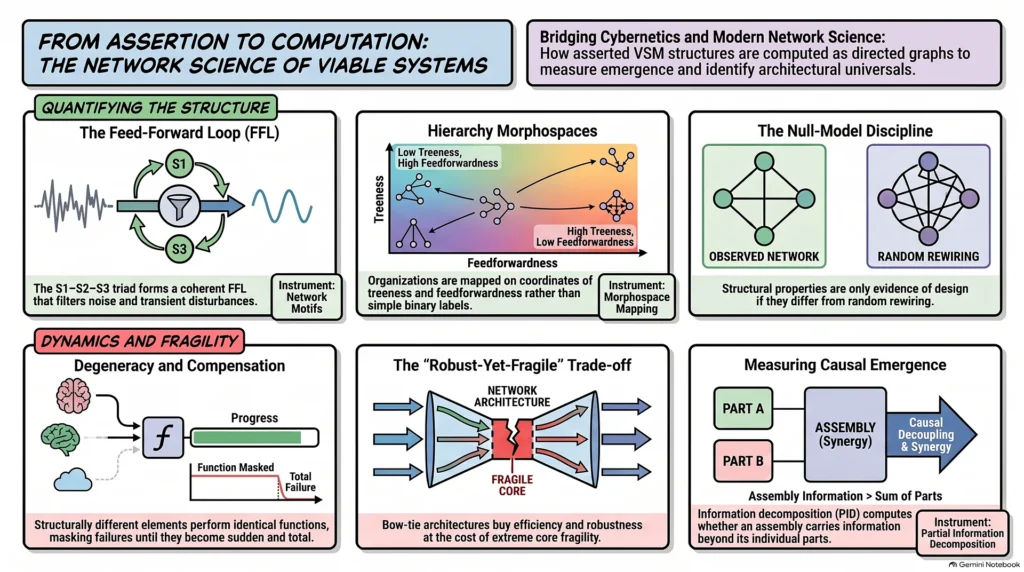
Network science and systems biology — the model as a graph
Area. Network motifs and the feed-forward loop; hierarchy measures; degeneracy; bow-tie architectures and robust-yet-fragile; causal emergence.
Introduction. Treat the VSM as a directed graph and a set of computable questions opens. Alon’s group showed that the coherent feed-forward loop — the S1→S2→S3 plus S1→S3 topology — is a sign-sensitive delay element: it filters transient inputs in one direction only, which is what Beer asserted System Two does. Corominas-Murtra and colleagues placed real networks in a three-dimensional hierarchy morphospace, so “hierarchy or heterarchy” becomes a coordinate. Edelman and Gally’s degeneracy explains why structural necessity claims are untestable in principle and why Schwaninger’s H3 came out null. Csete and Doyle’s bow tie is the VSM’s shape, and Friedlander showed the core’s width equals the rank of the goal matrix — a formula for metasystem size. Rosas and colleagues made emergence measurable on observational time series.
Three names. Uri Alon, John Doyle, Ricard Solé; and Fernando Rosas / Pedro Mediano for emergence.
Importance for cybernetics / VSM. The VSM has never been analysed as a graph. Its strongest available structural result — the FFL — has never been claimed by the tradition; its missing failure mode — robust yet fragile — has never been acknowledged.
Importance for the article. Demonstration II (§7) and Demonstration IV (§9) are built here; §11.4 uses the bow-tie result; all of it presupposes a formal specification that only exists if Beer (1962) contains one.
Start here.
- the motif and its function.
- the morphospace.
- why necessity claims resist testing.
- and — the shape and the width formula.
One outside text. Alon, U. (2006). An Introduction to Systems Biology: Design Principles of Biological Circuits. Chapman & Hall/CRC — the textbook behind 7.1 and 7.4.
More Details
This theme supplies the instruments Demonstration IV (§9) and the subgraph claim of Demonstration II (§7.1, IIb) depend on: the VSM treated as a directed graph whose structure, function and failure modes can be computed rather than asserted. Network motifs give the S1–S2–S3 triad a known dynamical function; hierarchy morphospaces give the hierarchy-versus-heterarchy dispute a coordinate and a null model; degeneracy explains why structural necessity claims are untestable and prescribes perturbation-based measurement; bow-tie theory makes metasystem width computable and names the fragility every added regulator buys; information decomposition makes emergence measurable on time series. Take the sub-themes in spec order: 7.1 and 7.2 are purely structural, 7.3 and 7.4 add function and failure, and 7.5 needs everything before it.
Network motifs and the feed-forward loop
A network motif is a small subgraph—three or four nodes with a specified pattern of directed edges—that occurs in a real network significantly more often than in randomised networks with the same degree sequence. Milo and colleagues introduced the method in 2002 by scanning transcription networks, neural wiring, food
Measuring hierarchy and heterarchy
Whether a directed network is a hierarchy is not a yes-or-no question. Network science has produced several quantitative measures, of which the most useful for the VSM is the morphospace of Corominas-Murtra, Goñi, Solé and Rodríguez-Caso. They condense a directed graph to its acyclic skeleton and compute three coordinates:
Degeneracy
Degeneracy is the ability of structurally different elements to perform the same function or produce the same output. Edelman and Gally distinguished it from redundancy, where identical copies do the same job, and argued that it is ubiquitous in biology—the genetic code, immune recognition, metabolic pathways, neural circuits, population-level
Bow-tie architectures and the robust-yet-fragile trade-off
A bow tie (or hourglass) is an architecture in which many diverse inputs fan in to a small conserved core of common currencies and protocols, which then fans out to many diverse outputs. Csete and Doyle proposed it as a recurring pattern in metabolism (many nutrients, a dozen precursors
Causal emergence and information decomposition
Emergence is usually asserted. Information theory now offers ways to measure one version of it. Partial information decomposition (PID), introduced by Williams and Randall Beer in 2010, splits the information several sources carry about a target into unique, redundant and synergistic parts; synergy is information available only from sources