
General systems theory and rival minimal sets
Area. Bertalanffy’s GST; Miller’s living systems theory; Troncale’s systems process theory; Rosen’s relational biology; von Neumann’s self-reproducing automata; Simon’s near-decomposability.
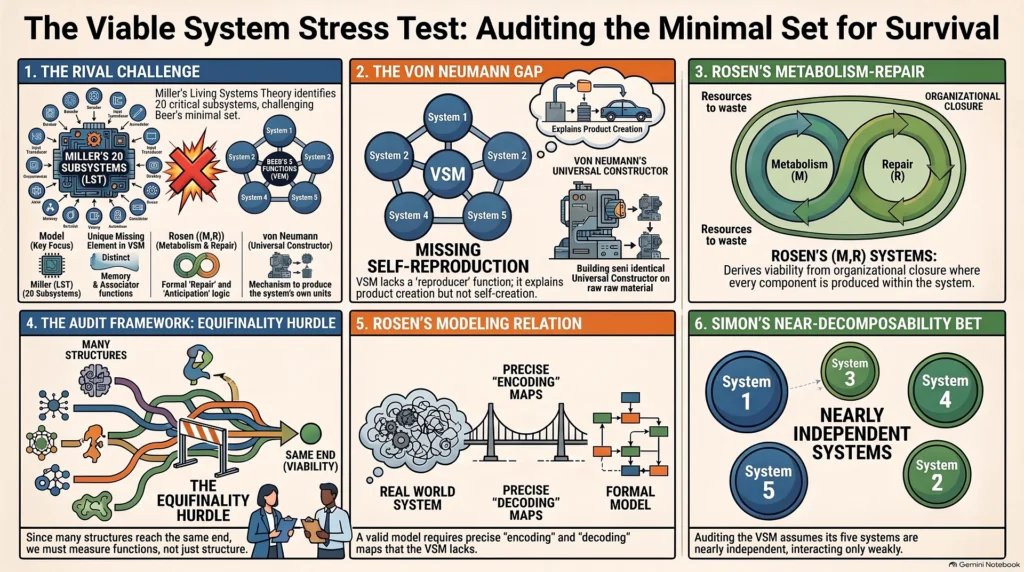
Introduction. Beer’s is not the only claim that a bounded system needs a fixed set of functions to persist. Miller specified twenty critical subsystems at eight nested levels, with one — the decider — that cannot be dispersed to another system; Beer’s five and Miller’s twenty were published six years apart and never compared. Rosen derived a minimal set formally (metabolism plus repair) and made the modelling relation — encoding, decoding, commutation — a checkable requirement that the VSM has never met. Von Neumann proved what self-reproduction requires; the VSM has no reproducer. Bertalanffy’s equifinality says the same end state is reachable by different paths, which undercuts any one-structure prescription. Simon’s near-decomposability is the assumption the whole receipt protocol rests on: that claims can be tested one at a time.
Three names. James Grier Miller, Robert Rosen, Herbert Simon.
Importance for cybernetics / VSM. These are the VSM’s siblings. The community’s failure to engage Miller is one of the four negative claims the paper must settle by database search before deposit.
Importance for the article. §2.5 and §12.7 name the decomposability bet; §3.3 tables the rival minimal sets; §10.5 lists the Miller crosswalk as the cheapest decisive study; §2.2 uses Rosen’s modelling relation to make the instrumental/constitutive distinction technical.
Start here.
- the direct rival; read the summary paper (Miller & Miller 1990) first, then the chapters on the decider and dispersal.
- short, essential.
- chapters on the modelling relation.
One outside text. Louie, A. H. (2009). More Than Life Itself: A Synthetic Continuation in Relational Biology. Ontos Verlag — the accessible route into Rosen’s formalism.