
Organization theory, design and failure
Area. Information-processing and sociotechnical views of design; organizational ecology; learning and exploration/exploitation; voice and silence; accidents, incubation, normalisation of deviance, high-reliability organising; institutional analysis.
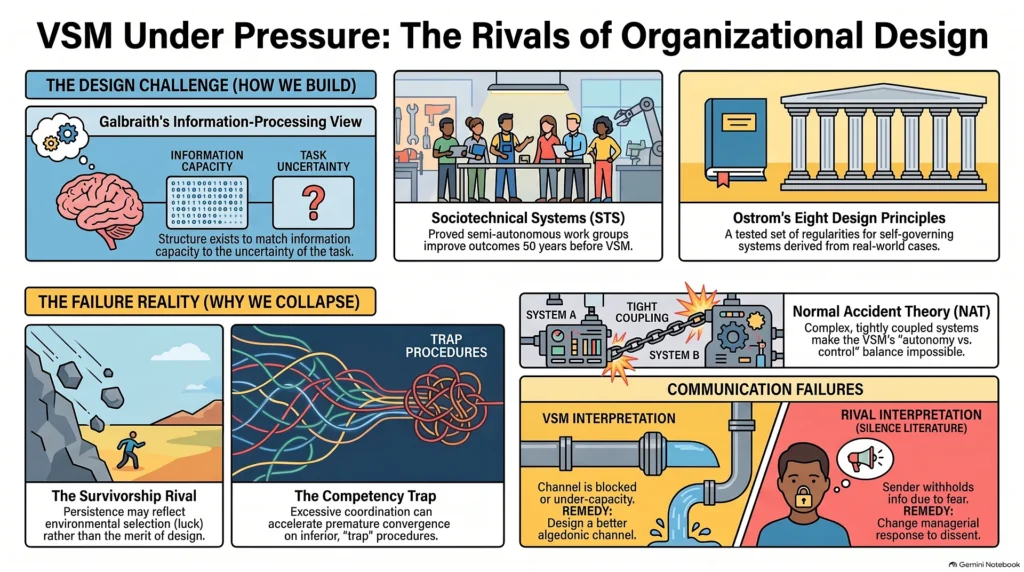
Introduction. Organization theory reached several of Beer’s conclusions independently and several opposite ones. Galbraith reframed design as information processing; Trist and Bamforth showed that technical design has social consequences. Hannan and Freeman argued that survival is selection, not design, and that reliability produces inertia — the rival every viability claim must name. March showed that coordination can trap an organisation on a local optimum. Morrison and Milliken located the failure of upward signalling at the sender, not the channel. Perrow argued that interactively complex, tightly coupled systems can be neither centralised nor decentralised and that switching between the two — Beer’s design — is infeasible; Turner and Vaughan described how failures incubate below every monitored threshold. Ostrom’s design principles are the precedent for a principle set that was later systematically tested.
Three names. Charles Perrow, Michael Hannan (with John Freeman), Elizabeth Wolfe Morrison.
Importance for cybernetics / VSM. This is the literature the VSM never met. Its pathology taxonomy, derived from the model, cannot name incubation, normalisation of deviance, competency traps or structural inertia.
Importance for the article. §3.3 lists the unnamed pathologies; §10.5 stages Perrow versus Beer as an adversarial receipt; §11.3 adds the survivorship rival; §13.1 uses organizational silence against the architectural theory of escalation the algedonic channel embodies.
Start here.
- chapter 3 on complexity and coupling; the centralisation contradiction.
- the rival mechanism for algedonics.
- selection versus design.
One outside text. Reason, J. (1997). Managing the Risks of Organizational Accidents. Ashgate — the latent-conditions model that connects Perrow, Turner and the HRO literature.