
Philosophy of science and metascience — the method
Area. Popper, Lakatos and the Duhem–Quine problem; the reproducibility literature (many-analysts studies, preregistration, Registered Reports); reliability statistics.
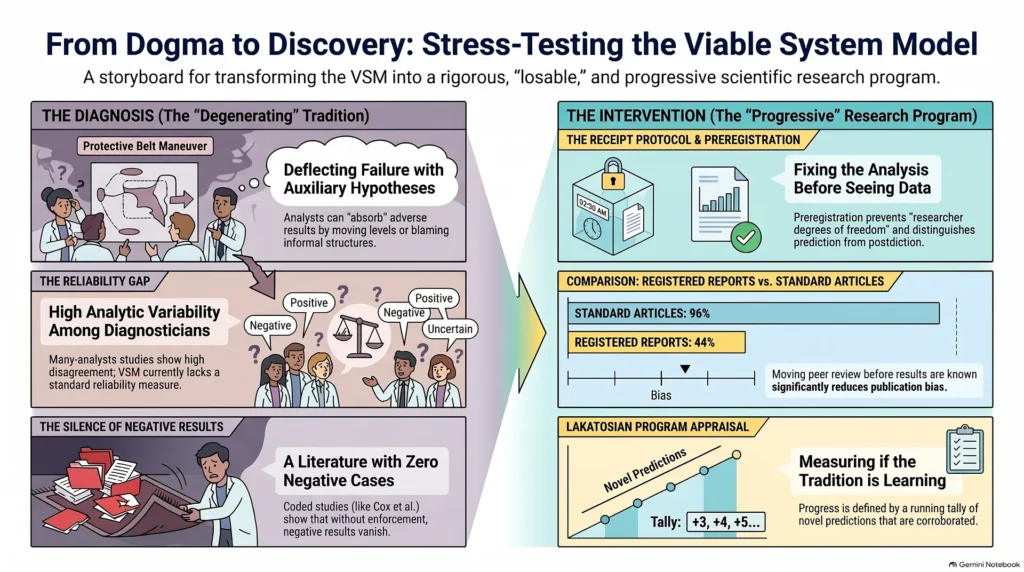
Introduction. Popper made falsifiability the demarcation of science; Duhem and Quine showed that no claim faces a test alone, so any refutation can be deflected onto an auxiliary. Lakatos’s answer is to judge research programmes, not claims: a programme is progressive when its adjustments yield novel corroborated predictions, degenerating when they only absorb anomalies. Metascience since 2011 has measured how much researcher freedom shapes results (29 teams, one dataset, opposite conclusions), how little voluntary preregistration constrains (three-quarters of preregistered studies deviate), and how much a gatekeeper changes (96% positive results in the standard literature, 44% in Registered Reports). Cox, Arnold and Villamayor-Tomás did for Ostrom’s design principles what the paper proposes for Beer’s: coded 91 studies against them and reformulated the principles.
Three names. Imre Lakatos; Brian Nosek and Chris Chambers (Registered Reports); Klaus Krippendorff (alpha).
Importance for cybernetics / VSM. Van der Zouwen inventoried the cybernetics literature twice and found the proportion of empirically tested claims declining. The VSM has no protocol of its own for saying what would count against it.
Importance for the article. The receipt protocol (§4), the programme-level appraisal (§4.7, §12.8), the preregistered low-agreement prediction in Demonstration III (§8), and the Registered Reports adoption route (§10.6) all come from here. A reviewer will ask why a register would work when preregistration mostly does not; §10.6 is the answer.
Start here.
- the appraisal criterion the paper adopts.
- why the register must be enforced at publication.
- the base rate Demonstration III predicts against.
- the executed precedent.
One outside text. Chambers, C. (2017). The Seven Deadly Sins of Psychology: A Manifesto for Reforming the Culture of Scientific Practice. Princeton University Press — the case for Registered Reports from their originator.