
General systems theory and rival minimal sets
Area. Bertalanffy’s GST; Miller’s living systems theory; Troncale’s systems process theory; Rosen’s relational biology; von Neumann’s self-reproducing automata; Simon’s near-decomposability.
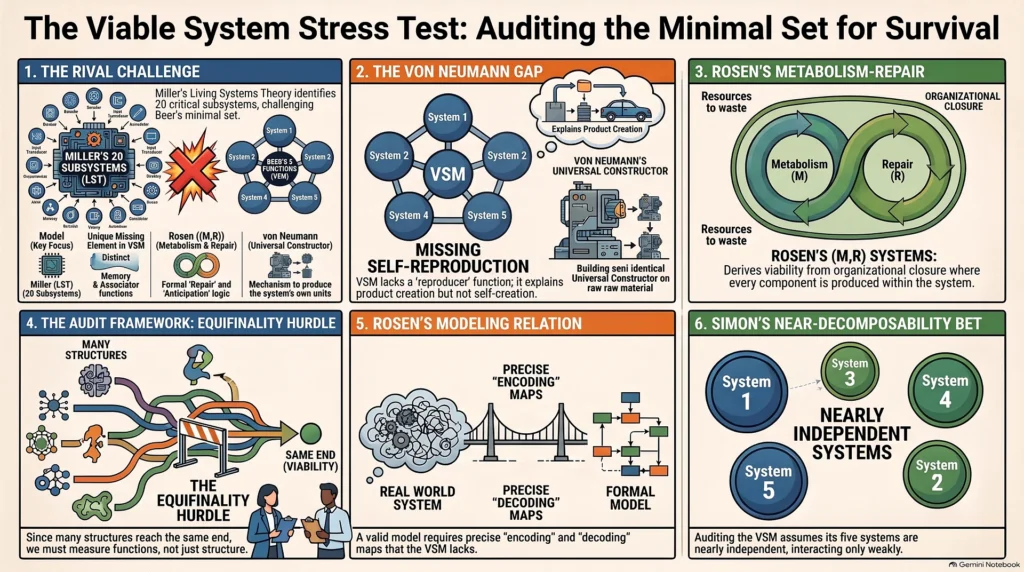
Introduction. Beer’s is not the only claim that a bounded system needs a fixed set of functions to persist. Miller specified twenty critical subsystems at eight nested levels, with one — the decider — that cannot be dispersed to another system; Beer’s five and Miller’s twenty were published six years apart and never compared. Rosen derived a minimal set formally (metabolism plus repair) and made the modelling relation — encoding, decoding, commutation — a checkable requirement that the VSM has never met. Von Neumann proved what self-reproduction requires; the VSM has no reproducer. Bertalanffy’s equifinality says the same end state is reachable by different paths, which undercuts any one-structure prescription. Simon’s near-decomposability is the assumption the whole receipt protocol rests on: that claims can be tested one at a time.
Three names. James Grier Miller, Robert Rosen, Herbert Simon.
Importance for cybernetics / VSM. These are the VSM’s siblings. The community’s failure to engage Miller is one of the four negative claims the paper must settle by database search before deposit.
Importance for the article. §2.5 and §12.7 name the decomposability bet; §3.3 tables the rival minimal sets; §10.5 lists the Miller crosswalk as the cheapest decisive study; §2.2 uses Rosen’s modelling relation to make the instrumental/constitutive distinction technical.
Start here.
- the direct rival; read the summary paper (Miller & Miller 1990) first, then the chapters on the decider and dispersal.
- short, essential.
- chapters on the modelling relation.
One outside text. Louie, A. H. (2009). More Than Life Itself: A Synthetic Continuation in Relational Biology. Ontos Verlag — the accessible route into Rosen’s formalism.
More Details
This theme covers the general-systems traditions that answered, independently of Beer, the question the VSM answers: what functions must any persisting system have? It matters for the paper because §3.3 of v02 now argues that the VSM’s five functions are one candidate minimal set among several — Miller’s twenty subsystems, Rosen’s metabolism and repair, von Neumann’s constructor — and that the five have never been compared with any of them. A co-author must be able to state each rival precisely, say what the VSM lacks relative to their convergence, and defend the claim that the VSM’s claim-structure is decomposable enough to be audited claim by claim. Take the sub-themes in spec order: Bertalanffy gives the vocabulary (open system, equifinality) the others assume; Miller is the direct rival and the cheapest study; Troncale and Rosen are the two rivals that stress the receipt schema itself; von Neumann isolates the single sharpest gap; Simon closes with the bet the whole protocol rests on.
General System Theory and equifinality
General System Theory (GST) is Bertalanffy’s programme, begun in theoretical biology in the 1930s and consolidated in the 1968 collection, for a science of principles valid for systems of any kind. Its core concepts are the open system, which maintains itself by continuous exchange of matter and energy with
Living Systems Theory (Miller)
Living Systems Theory (LST) is James Grier Miller’s claim that all living systems, from the cell to the supranational system, are organised on nested levels and that every level must carry out the same set of critical subsystems. The levels were seven in the 1978 book and eight once
Systems Process Theory (Troncale)
Systems Process Theory (SPT) is Len Troncale’s attempt to build a general theory of systems not from a list of isomorphies but from the relations among them. The 1978 chapter identifies some fifty principal systems concepts — hierarchy, feedback, cycles, boundaries, emergence, and so on — and proposes "linkage
Relational biology and anticipatory systems (Rosen)
Relational biology, founded by Nicolas Rashevsky and developed by Robert Rosen, asks what organisation a system must have to be alive, abstracting from the material it is made of. Rosen’s answer is the (M,R)-system: a metabolism component that converts inputs to outputs, and a repair component that regenerates the
Self-reproduction and what the VSM lacks (von Neumann)
Von Neumann asked, in lectures from 1948 and an unfinished manuscript completed by Arthur Burks, what logical organisation an automaton needs to build a copy of itself. His answer separates four parts: a universal constructor that can build any automaton from a description; a copier that duplicates a description;
Near-decomposability and hierarchy (Simon)
Simon’s 1962 paper argues that complex systems in nature and society are almost always hierarchic — systems of subsystems of subsystems — and explains why: hierarchic assemblies evolve faster and survive interruption better, illustrated by the parable of the watchmakers Hora, who builds in stable sub-assemblies, and Tempus, who