
Organization theory, design and failure
Area. Information-processing and sociotechnical views of design; organizational ecology; learning and exploration/exploitation; voice and silence; accidents, incubation, normalisation of deviance, high-reliability organising; institutional analysis.
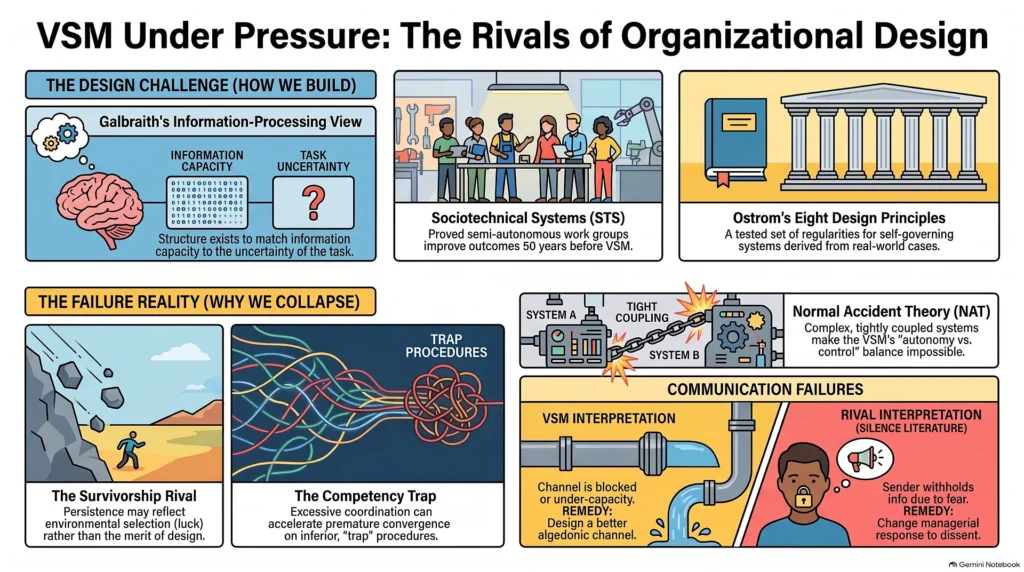
Introduction. Organization theory reached several of Beer’s conclusions independently and several opposite ones. Galbraith reframed design as information processing; Trist and Bamforth showed that technical design has social consequences. Hannan and Freeman argued that survival is selection, not design, and that reliability produces inertia — the rival every viability claim must name. March showed that coordination can trap an organisation on a local optimum. Morrison and Milliken located the failure of upward signalling at the sender, not the channel. Perrow argued that interactively complex, tightly coupled systems can be neither centralised nor decentralised and that switching between the two — Beer’s design — is infeasible; Turner and Vaughan described how failures incubate below every monitored threshold. Ostrom’s design principles are the precedent for a principle set that was later systematically tested.
Three names. Charles Perrow, Michael Hannan (with John Freeman), Elizabeth Wolfe Morrison.
Importance for cybernetics / VSM. This is the literature the VSM never met. Its pathology taxonomy, derived from the model, cannot name incubation, normalisation of deviance, competency traps or structural inertia.
Importance for the article. §3.3 lists the unnamed pathologies; §10.5 stages Perrow versus Beer as an adversarial receipt; §11.3 adds the survivorship rival; §13.1 uses organizational silence against the architectural theory of escalation the algedonic channel embodies.
Start here.
- chapter 3 on complexity and coupling; the centralisation contradiction.
- the rival mechanism for algedonics.
- selection versus design.
One outside text. Reason, J. (1997). Managing the Risks of Organizational Accidents. Ashgate — the latent-conditions model that connects Perrow, Turner and the HRO literature.
More Details
This theme covers the organisation-theory literatures that either rediscovered the VSM’s logic independently, supply rival mechanisms for the outcomes the VSM claims to explain, or document failures the VSM cannot name. v02 §3.3 rebuilt the "neighbouring literatures" from a convenience sample into a survey, and most of the additions are here: survival as selection rather than design, accidents as consequences of structure rather than pathologies, silence at the sender rather than failure in the channel, competency traps that coordination accelerates, and Ostrom’s principles as the precedent for a tested design set. A co-author must be able to state each rival as a prediction that differs from the VSM’s, not as a competing vocabulary. Take the sub-themes in spec order, with one exception: read 4.7 (Ostrom and Cox) immediately after 4.1 and 4.2, because Cox et al. is the paper’s methodological precedent (§3.4) and the reader should hold it in mind while reading the rivals in 4.3–4.6.
The information-processing view of organization design
Galbraith’s proposition is that the greater the uncertainty of a task, the more information must be processed among decision-makers during its execution, and that organisation structure exists to match information-processing capacity to that load. Uncertainty is defined as the gap between the information a task requires and the information
Sociotechnical systems
Sociotechnical systems (STS) theory holds that the technical and social organisation of work are interdependent and must be designed jointly; optimising either alone degrades the whole. The founding study is Trist and Bamforth’s account of British coal mines after mechanisation: the longwall method broke small, self-selecting, multi-skilled work groups
Organizational ecology, inertia and the survivorship rival
Organisational ecology explains the diversity of organisational forms by selection at the population level rather than by adaptation of individual organisations. Hannan and Freeman’s 1977 paper set out the programme: founding and mortality rates, niche width, the specialist–generalist distinction and competition among populations, with formal models borrowed from bioecology.
Learning, exploration/exploitation and competency traps
March’s 1991 paper frames organisational learning as an allocation between exploration (search, variation, experimentation, whose returns are distant and uncertain) and exploitation (refinement, efficiency, whose returns are near and reliable). Two models carry the argument. In the first, individuals learn from an organisational code and the code learns from
Organizational silence and voice
The silence-and-voice literature asks why employees withhold information, concerns and suggestions from those above them, and what follows. Morrison and Milliken (2000) defined organisational silence as a collective phenomenon: a climate in which employees believe that speaking up is futile or dangerous, produced by managerial beliefs (employees are self-interested,
Accidents, reliability and the failure literatures
Four bodies of work describe how organisations fail. Normal accident theory (Perrow) classifies systems by interactive complexity (unplanned, non-linear interactions) and coupling (how tightly one step follows another); where both are high, accidents are consequences of system properties rather than pathologies, and the organisational requirements are contradictory, because complexity
Institutional analysis and the commons
Ostrom’s Governing the Commons argued, against the standard prediction that common-pool resources are either privatised, nationalised or destroyed, that resource users devise durable self-governing institutions. From cases of irrigation systems, fisheries, forests and groundwater basins that endured or collapsed she extracted eight design principles: clearly defined boundaries; congruence between