
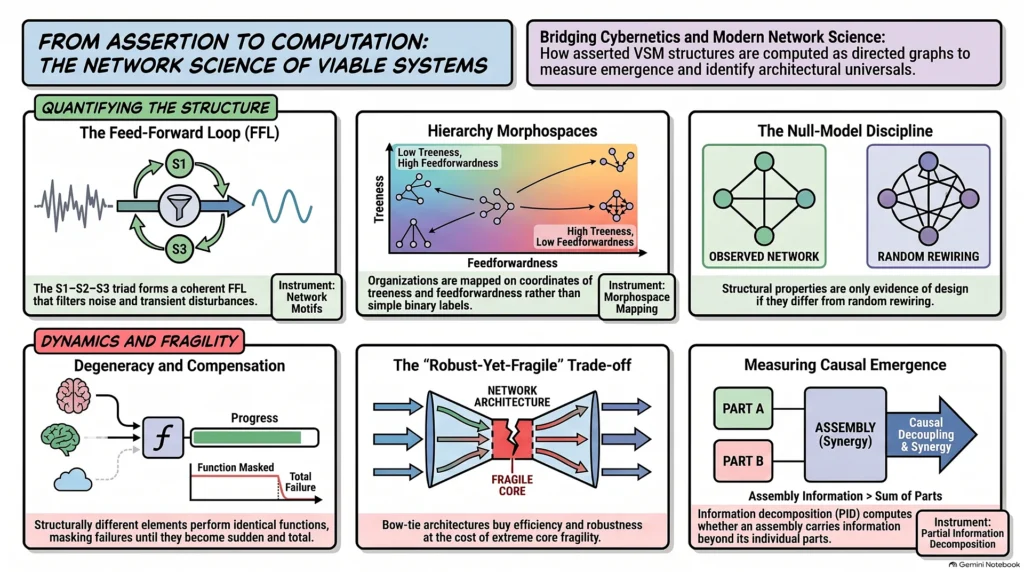
Network science and systems biology — the model as a graph
Area. Network motifs and the feed-forward loop; hierarchy measures; degeneracy; bow-tie architectures and robust-yet-fragile; causal emergence.
Introduction. Treat the VSM as a directed graph and a set of computable questions opens. Alon’s group showed that the coherent feed-forward loop — the S1→S2→S3 plus S1→S3 topology — is a sign-sensitive delay element: it filters transient inputs in one direction only, which is what Beer asserted System Two does. Corominas-Murtra and colleagues placed real networks in a three-dimensional hierarchy morphospace, so “hierarchy or heterarchy” becomes a coordinate. Edelman and Gally’s degeneracy explains why structural necessity claims are untestable in principle and why Schwaninger’s H3 came out null. Csete and Doyle’s bow tie is the VSM’s shape, and Friedlander showed the core’s width equals the rank of the goal matrix — a formula for metasystem size. Rosas and colleagues made emergence measurable on observational time series.
Three names. Uri Alon, John Doyle, Ricard Solé; and Fernando Rosas / Pedro Mediano for emergence.
Importance for cybernetics / VSM. The VSM has never been analysed as a graph. Its strongest available structural result — the FFL — has never been claimed by the tradition; its missing failure mode — robust yet fragile — has never been acknowledged.
Importance for the article. Demonstration II (§7) and Demonstration IV (§9) are built here; §11.4 uses the bow-tie result; all of it presupposes a formal specification that only exists if Beer (1962) contains one.
Start here.
- the motif and its function.
- the morphospace.
- why necessity claims resist testing.
- and — the shape and the width formula.
One outside text. Alon, U. (2006). An Introduction to Systems Biology: Design Principles of Biological Circuits. Chapman & Hall/CRC — the textbook behind 7.1 and 7.4.