
Cognitive science and philosophy of mind
Area. Distributed cognition; the extended-mind debate; predictive processing, the free-energy principle and Markov blankets; coordination dynamics.
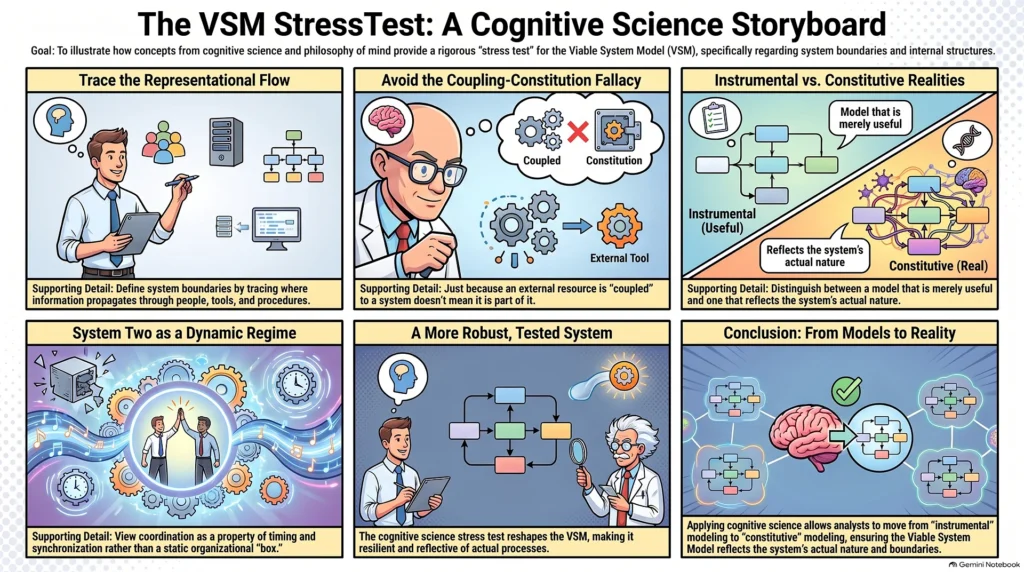
Introduction. Hutchins studied cognition as a property of socio-technical systems — a ship’s bridge, a cockpit — and derived the system’s boundary from where representational state actually flows, rather than declaring it. Clark and Chalmers asked when an external resource is part of a mind, and Adams, Aizawa and Rupert answered that coupling is not constitution. Predictive processing (Clark, Friston) explains perception, action and coordination with a single principle — minimise prediction error across a hierarchy of timescales — and Bruineberg and colleagues showed that the field’s central construct, the Markov blanket, is used in two incompatible ways: a formal construct inside a model, and a metaphysical claim about where a real boundary lies. Kelso and Tognoli show coordination arising from dynamics without any coordinating organ.
Three names. Edwin Hutchins, Andy Clark, Jelle Bruineberg.
Importance for cybernetics / VSM. The VSM has no criterion for what is part of the system rather than coupled to it, and it has never engaged the field that spent 25 years on exactly that question.
Importance for the article. §2.2’s instrumental/constitutive distinction comes from Bruineberg; §2.4 splits the boundary question in two; Demonstration IIIb (§8) tests whether VSM analysts and cognitive ethnographers carve the same joints — a potential novel corroborated prediction.
Start here.
- the paper’s organising distinction.
- the boundary criterion; chapter on the navigation team.
One outside text. Parr, T., Pezzulo, G., & Friston, K. J. (2022). Active Inference: The Free Energy Principle in Mind, Brain, and Behavior. MIT Press — the standard exposition, needed to judge whether PP subsumes S2/S3/S4.