
Legend. ✓ text read (in the draft’s footnotes or in the 22 Sept research pass) · ◐ citation confirmed, content from abstract or secondary source · † not read / unverified · ✗ no source found
The Law We Quote Is Not the Law Ashby Wrote — the foundation we are most sure of
Area. The formal base of management cybernetics: Ashby’s law of requisite variety (1956), Beer’s design reading of it, the Conant–Ashby good regulator theorem (1970), and the results next to them in information theory, control theory and complexity science.
Introduction. The chapter separates three things the tradition has run together.
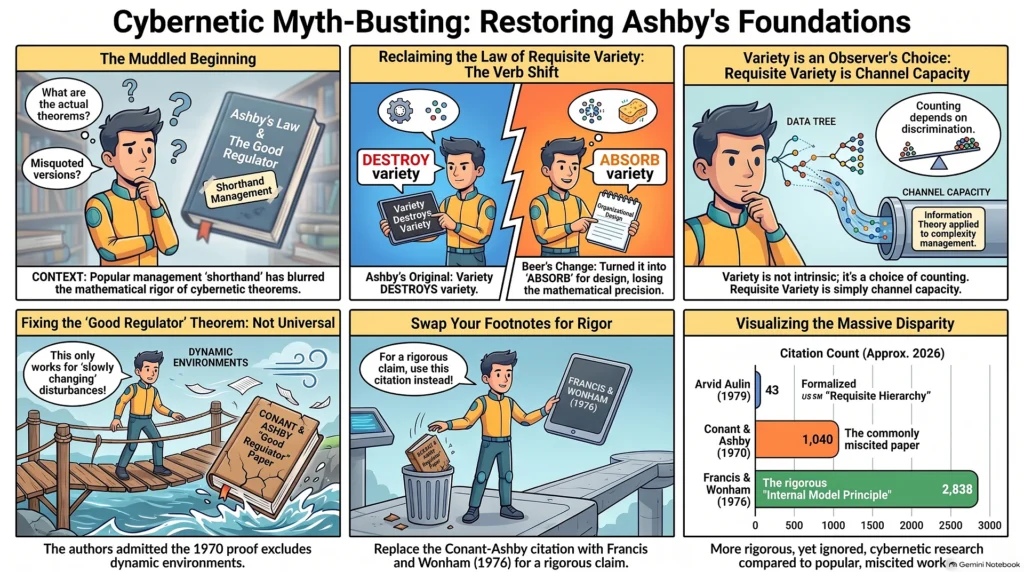
- A theorem. Ashby’s law is stated in Shannon’s notation. It is a priori, rests on a stipulation about the outcome table, and needs a constant k once that stipulation is relaxed. Ashby’s sentence is “only variety in R can force down the variety due to D; variety can destroy variety” (1956, §11/7).
- A design maxim. Beer’s “only variety can absorb variety” changes the verb and turns a bound into an instruction. It is the better sentence, and it travelled without the conditions.
- A claim about models. Conant & Ashby’s “every good regulator of a system must be a model of that system” has three problems:
- Its authors withdraw the universal quantifier inside the paper.
- The proof has no inputs, channels or noise.
- It scores a regulator by outcome entropy alone, whether the outcome is good or fatal.
The results that do carry the load are Francis & Wonham’s internal model principle (1976) and the Virgo et al. reconstruction (2025). Aulin’s law of requisite hierarchy (1979) supplied the derivation Beer’s recursion lacked, and the tradition barely cited it. Under all three sits one open question: who draws the distinctions that variety counts. Ashby named it himself, and it comes back at the system boundary and at the transducer.
Three names. W. Ross Ashby, Stafford Beer, Bruce Francis & W. Murray Wonham. After them: Nathaniel Virgo (the reconstruction) and Arvid Aulin (the uncited derivation).
Importance for cybernetics / VSM. The law is the one result the tradition can point to as proved, and System Four rests on the good regulator theorem. Where the citations are wrong, the foundations are mislabelled even where they hold.
Importance for the book. This is Part One, Chapter 3. It supplies the book’s cheapest receipt: one corrected citation practice, at no cost. It feeds:
- Ch 2: a System Four nobody listens to
- Ch 4: channels without owners. The C&A proof has no channels.
- Ch 5: the boundary as a partition
- Ch 12: variety logic outside the tradition (Galbraith, Aulin, Friston)
- Ch 18: Pfiffner’s operationalisation
- Ch 25: transducers
Start here.
- Ashby 1956, chs 7 and 11 (§11/5–11/11): read for the exact sentence, the table stipulation, k, the a priori claim and the Shannon homology.
- Conant & Ashby 1970, pp. 91 and 96: read for the optimality criterion and the three concessions that follow the proof.
- Francis & Wonham 1976: the result C&A are believed to have proved, with its scope conditions.
- Virgo, Biehl, Baltieri & Capucci 2025 (arXiv:2508.06326): being a model versus having one. The attributable model may be trivial.
One outside text. Siegenfeld, A. F. & Bar-Yam, Y. (2025). A formal definition of scale-dependent complexity and the multi-scale law of requisite variety. Entropy 27(8), 835. It generalises the law across scales and states outright that the result depends on how the system is coarse-grained. It is an outside formal version of the chapter’s partition problem ✓ (arXiv text).
What you should be able to say after this chapter
- Ashby’s law is a theorem in Shannon’s lineage: a priori, with a stipulation and a constant. It licenses arguments about whether an arrangement could work. It does not license numbers about a particular organisation.
- “Only variety can absorb variety” is Beer’s sentence, not Ashby’s. Quoting it under Ashby’s name quotes a design instruction as if it were a bound.
- The good regulator theorem does not prove its title, by its authors’ own concessions (p. 96). Cite Francis & Wonham for the rigorous claim and Virgo et al. for the reconstruction.
- Under the reconstruction, “System Four produces material but nothing moves” becomes a claim that can be disputed with evidence: the attributable model is trivial.
- Variety depends on the observer’s distinctions, and Ashby says so. Who counts the states, who draws the boundary and who specifies the transducer are one political choice in three places.
- When requisite variety was operationalised (Pfiffner 2017), what came out was the vocabulary (“sufficient to master challenges”), not the law.
- Work that supported the tradition formally was done outside it and went unread. Aulin has about 43 citations against about 1,040 for C&A (OpenAlex, 7 Aug 2026).
Details
Ashby’s law as written — the sections of ch. 11, Ashby 1958, versions of the sentence in circulation, the tautology objection
The good regulator theorem and its critics — C&A’s three concessions; Baez, Wentworth, Virgo et al.; the theorem in the free-energy literature
What carries the load instead — Francis & Wonham, Aulin, Heylighen’s requisite knowledge, Bar-Yam’s multiscale law
Who counts the states: partition and operationalisation — Ashby on the observer, one choice in three places, attempts at measurement, Pfiffner